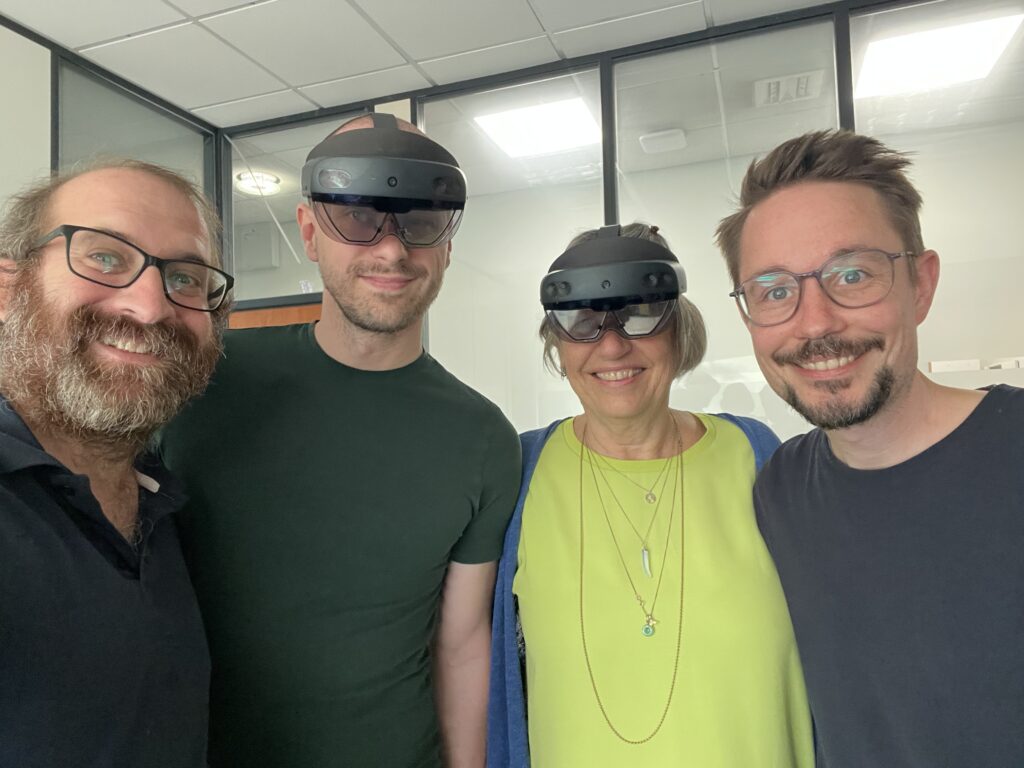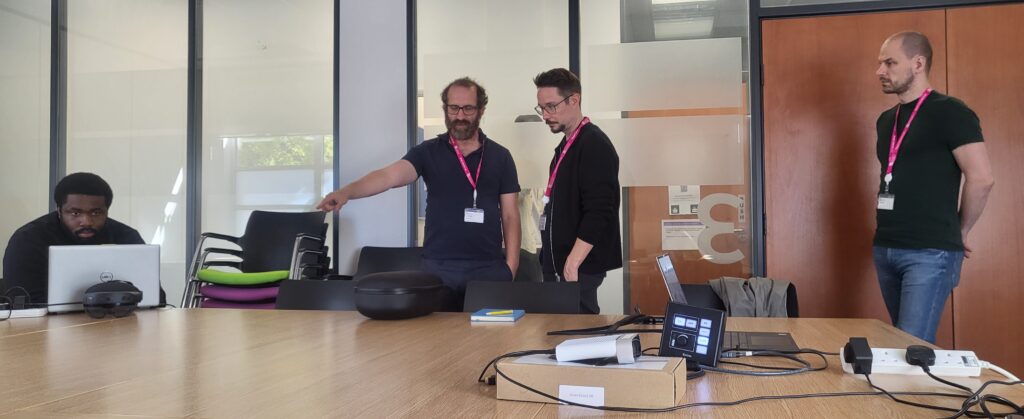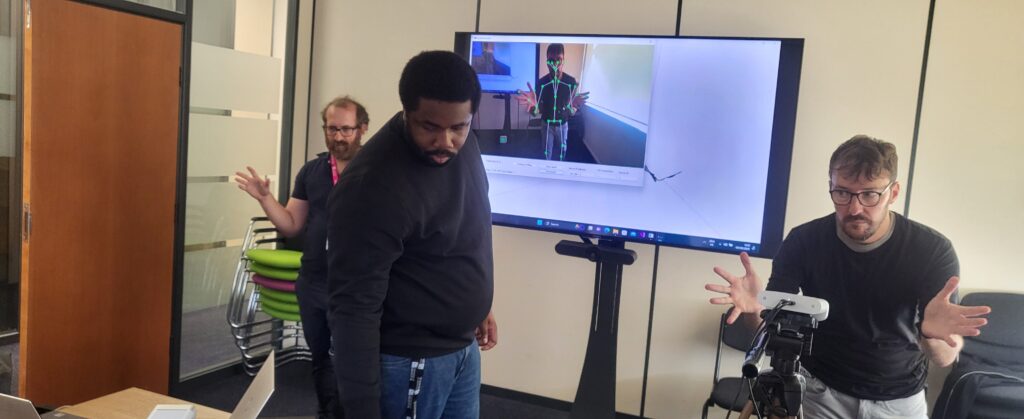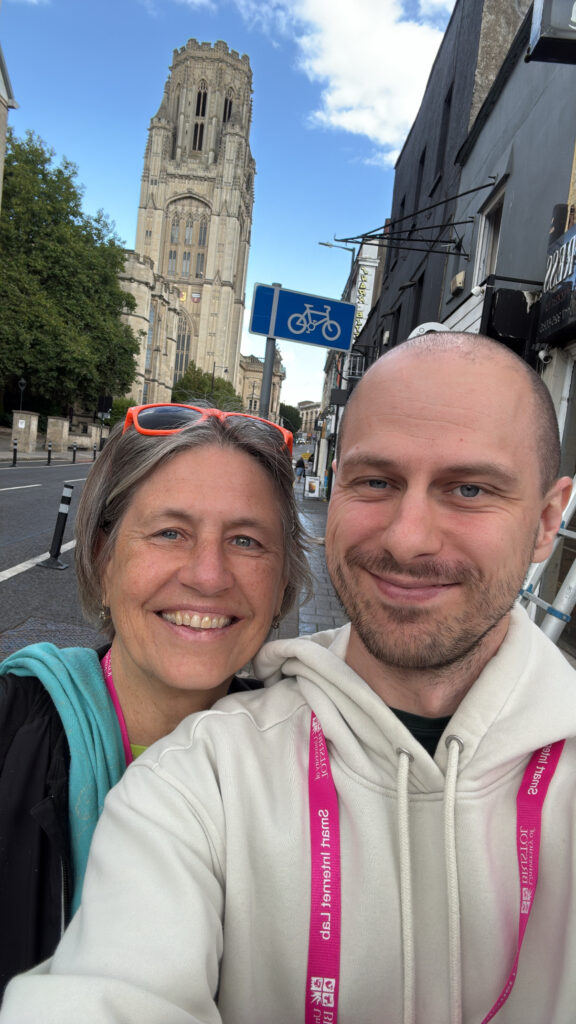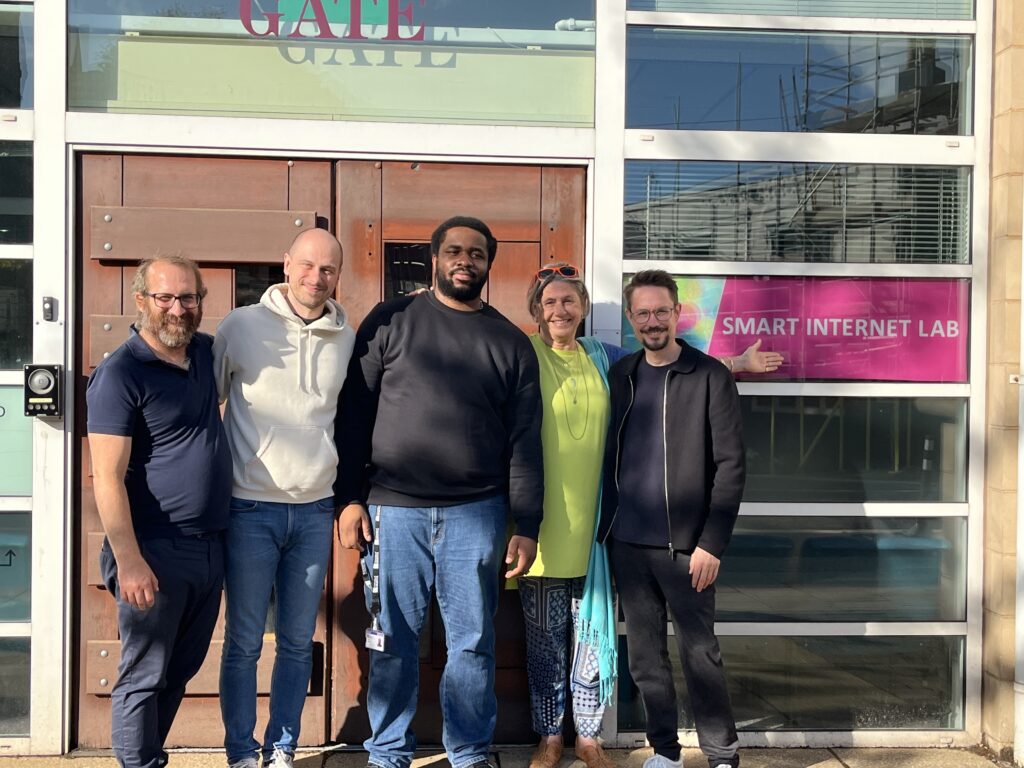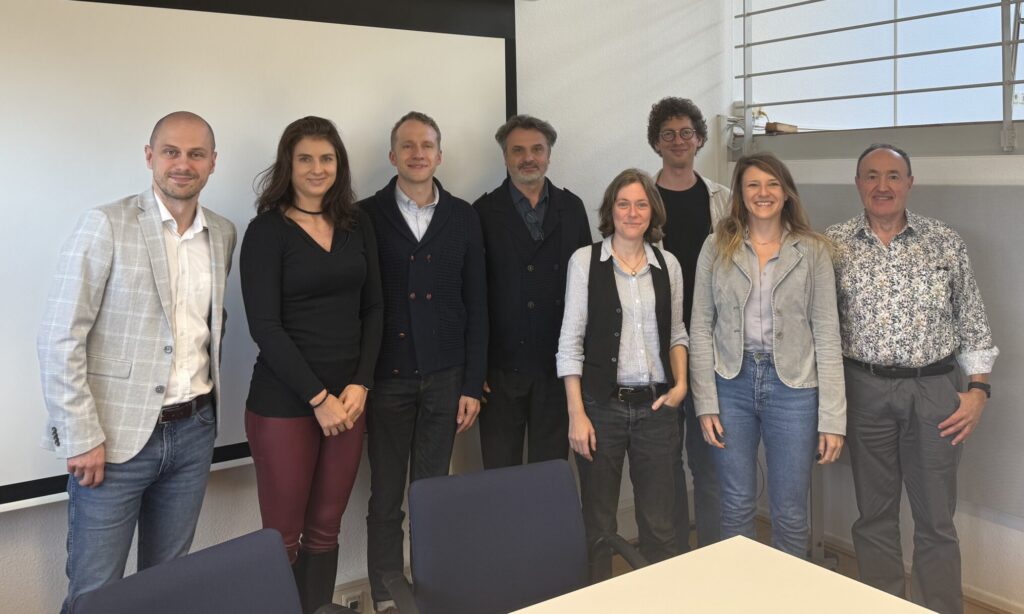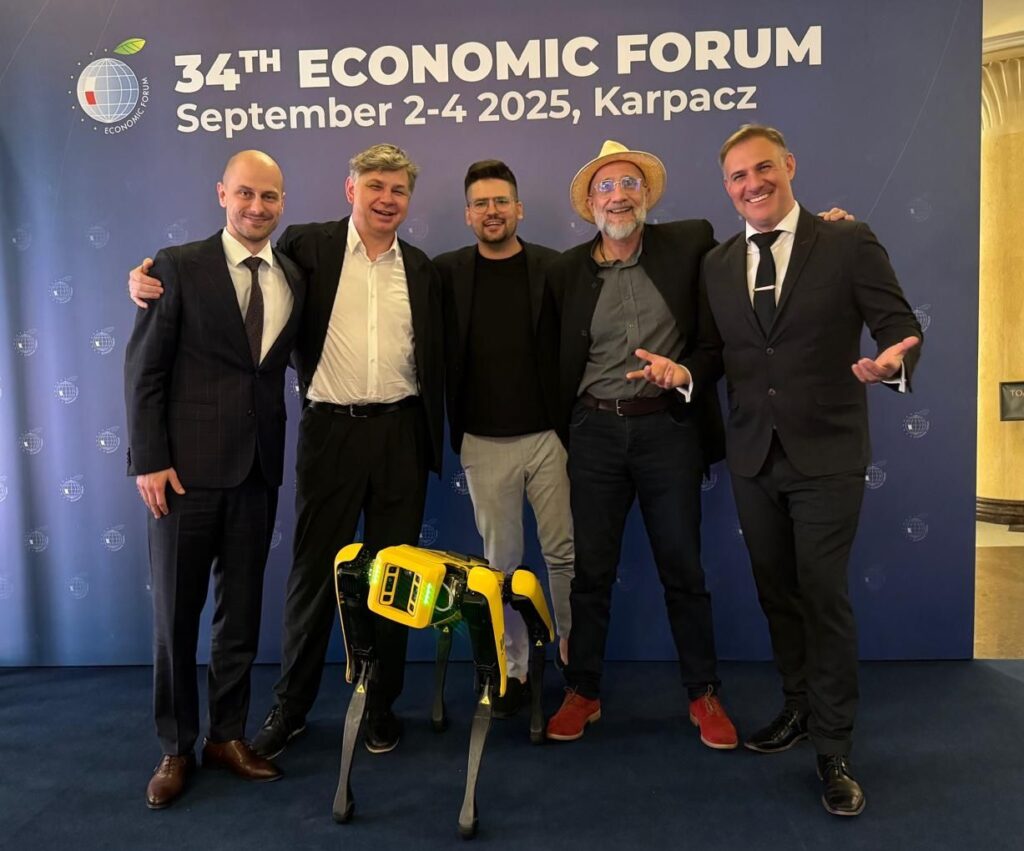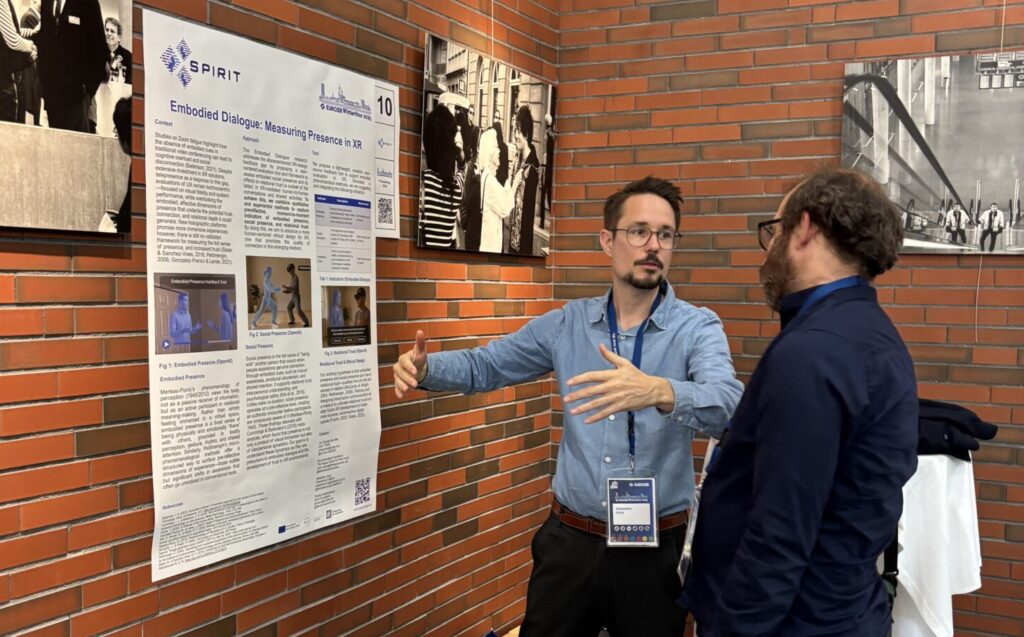
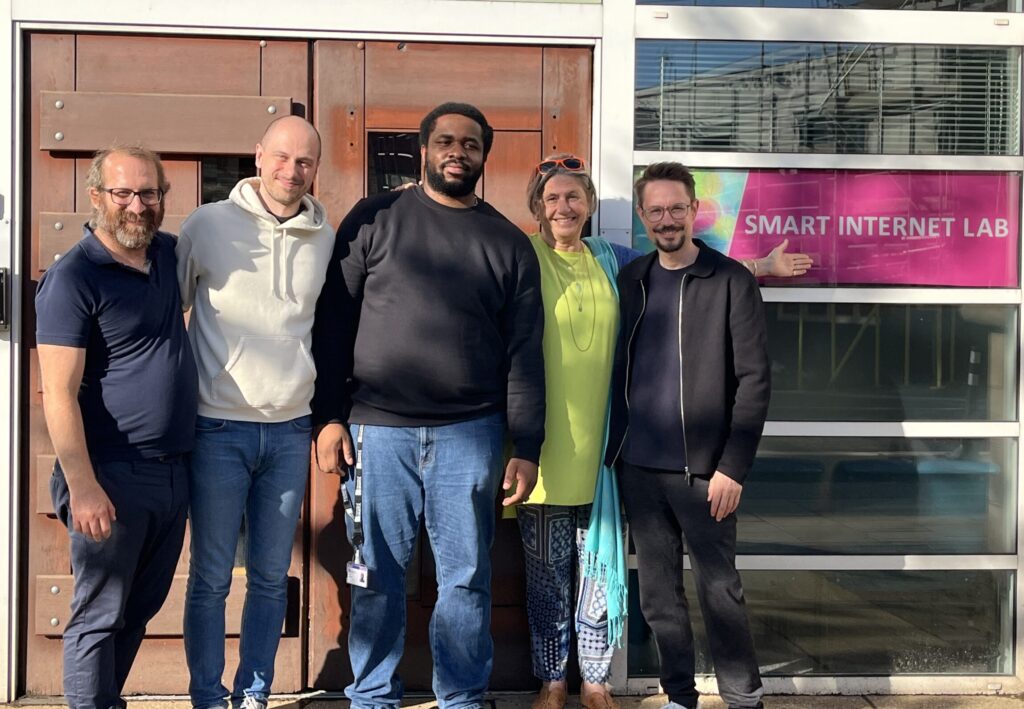
Bristol, 8 September 2025 — GAIA conducted a live pilot of Embodied Dialogue (ED) at the SPIRIT Testbed, University of Bristol, running 8–9 September 2025. The session brought together Uri Noy Meir, Sebastian Jung, Damian Ciachorowski and Anne-Marie Voorhoeve to evaluate how multi-source holographic XR can strengthen embodied social presence and relational trust in real-time, distributed conversations.
The Bristol pilot operationalised ED’s research design in a controlled XR environment, using a holographic, multi-participant setup to test SPIRIT’s capacity to support lifelike, co-present interaction. Up to 12 participants—including members of the design team—engaged in short, structured exchanges while facilitators captured experiential signals of presence and trust.
Grounded in Merleau-Ponty’s phenomenology of perception and micro-phenomenology, the ED framework treats the body as an active medium of meaning-making. In practice, ED combines brief self-report scales (five items each, adapted from established presence and trust literature) with phenomenological prompts and facilitator observations. This mixed-methods approach pairs quantitative ratings with fine-grained, pre-reflective insights—allowing teams to assess not only system performance but the felt sense of connection that underpins effective collaboration.
“Rather than assuming XR can replicate co-presence, we’re carefully exploring where it might support a more tangible sense of one another,” said Uri Noy Meir. “In Bristol we prototyped early test protocols that translate embodied, systemic practices into the XR context, so developers and researchers can learn—step by step—what may help trust emerge online.”
“At this stage, we are experimenting with ways to observe and self-assess aspects of embodied and social presence in mixed-reality telepresence technologies,” added Sebastian Jung. “These are exploratory indicators intended to guide future design by surfacing possibilities that could, over time, support hybrid embodied practices and experiential learning—rather than claim finished solutions today.”
“Observation is our first responsibility,” said Anne-Marie Voorhoeve. “By opening a careful space for noticing—how people orient, breathe and connect—we invite the technology community to place trust, coherence and presence at the centre of purpose. Implementation then becomes not only about what a system does, but how it supports relationships to form over time.”
Privacy-by-design governed the pilot: recordings were video-only (no audio); all materials were anonymised and tagged solely by session ID; observational notes focused on team performance or de-identified participant responses. Prior to each session, participants received clear briefings on objectives, ethics and technical setup.
Primary outputs from the Bristol pilot include a short anonymised dataset of scale responses and phenomenological notes, plus facilitator annotations to refine the Embodied Presence Feedback Tool for SPIRIT. These results will inform next iterations of ED protocols and help align SPIRIT’s mesh-based XR capabilities with human-centred requirements.
About Embodied Dialogue (ED). ED is a phenomenological evaluation framework for SPIRIT—Scalable Platform for Innovations on Real-time Immersive Telepresence—focusing on embodied presence, social presence and relational trust in XR-mediated conversations.